


Stiff clay with free water (Reese, 1975)
The p-y curve for stiff clays with free water is shown in Figure 1.
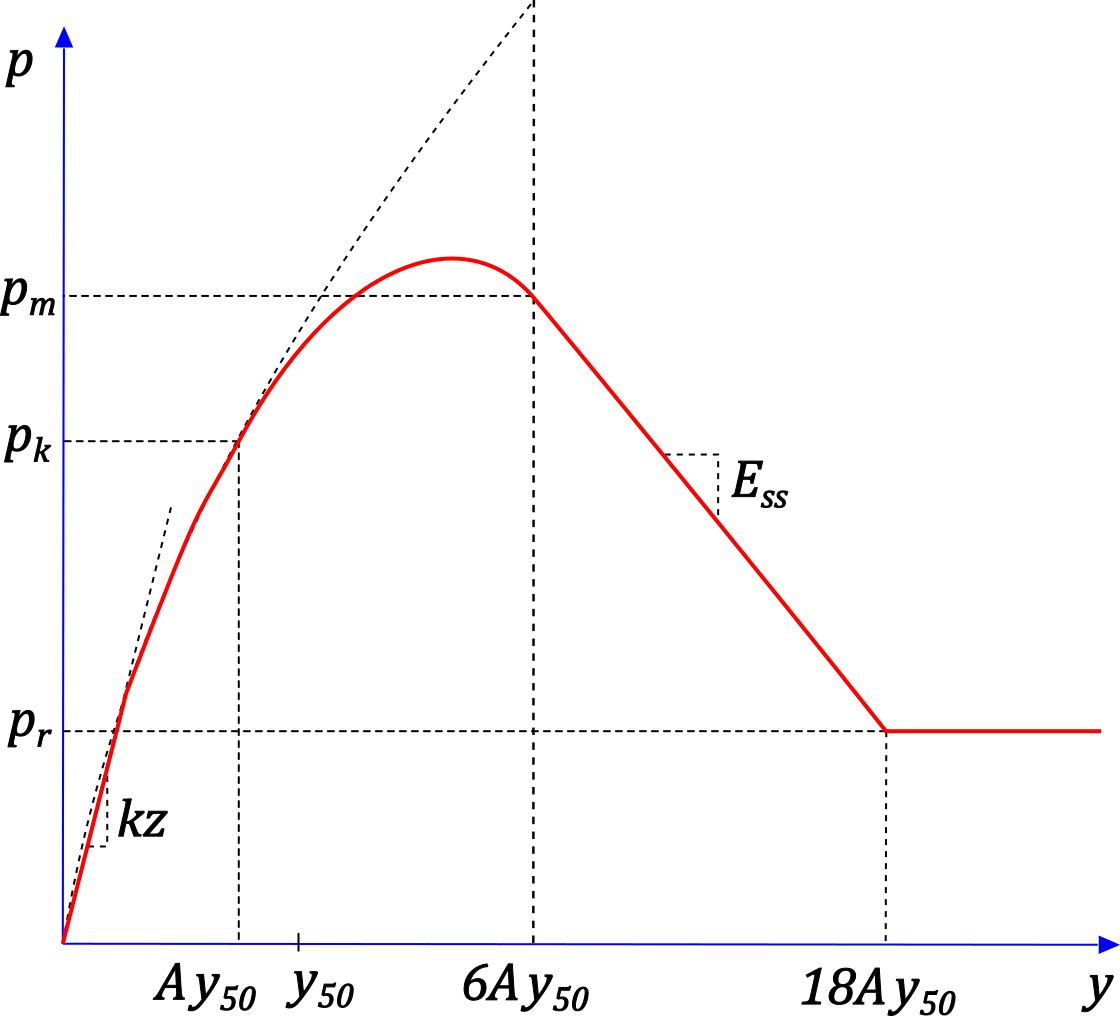 Figure 1: p-y curve for stiff clay with free water (Reese, 1975)
The input parameters for determining the curve are:
d [m] | – | pile diameter |
z [m] | – | depth below the ground surface |
γ [kN/m3] | – | unit weight of the soil |
cu [kPa] | – | undrained shear strength of the soil |
ε50 | – | strain corresponding to one-half of the ultimate soil resistance pu |
k [MN/m3] | – | initial soil stiffness |
The curve consists of four parts:
1. Linear part defined by the initial soil stiffness
2. Parabolic part
3. Linear part in which the soil resistance decreases to a residual value
4. Constant part after the residual soil resistance has been reached
The reference displacement y50 is given by:

To determine the shape of the curve, characteristic displacement values are specified that define the individual segments of the p-y curve:

where the coefficient A is determined from the chart in Figure 2 and takes the value As for static loading and Ac for cyclic loading.
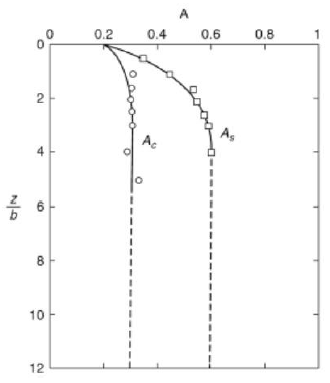 Figure 2: Values of coefficient A for static and cyclic loading
The ultimate soil resistance pu is taken as the smaller of the values:

Linear part 1 of the curve depends only on the initial soil stiffness and the depth below the ground surface. It is given by:

and applies in the range where it is lower than the parabolic part of the curve.
The parabolic part of the curve consists of two segments. The first segment applies from zero displacement up to the displacement yk and is given by:
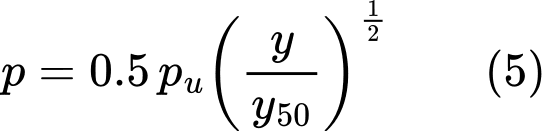
Between the displacements yk and ym, the parabolic part is reduced according to:

Between the displacements ym and yr, the p-y curve decreases linearly with the slope Ess

until it reaches the residual soil resistance pr at the displacement yr. Beyond that point, the curve remains constant at this value.
The overall shape of the curve is further influenced by the slope of linear part 1, which is defined by the initial soil stiffness k. Linear part 1 can intersect the parabola or other parts of the p-y curve. If it intersects the parabola, the curve consists of four parts, as shown in Figure 1. If it intersects the decreasing linear part, the parabolic part is absent and the curve consists of only three linear parts. If linear part 1 intersects the constant part, where the constant residual soil resistance has already been reached, the p-y curve is only bilinear.